Charts to visualize how much you owe Unity for their per-install Runtime Fee
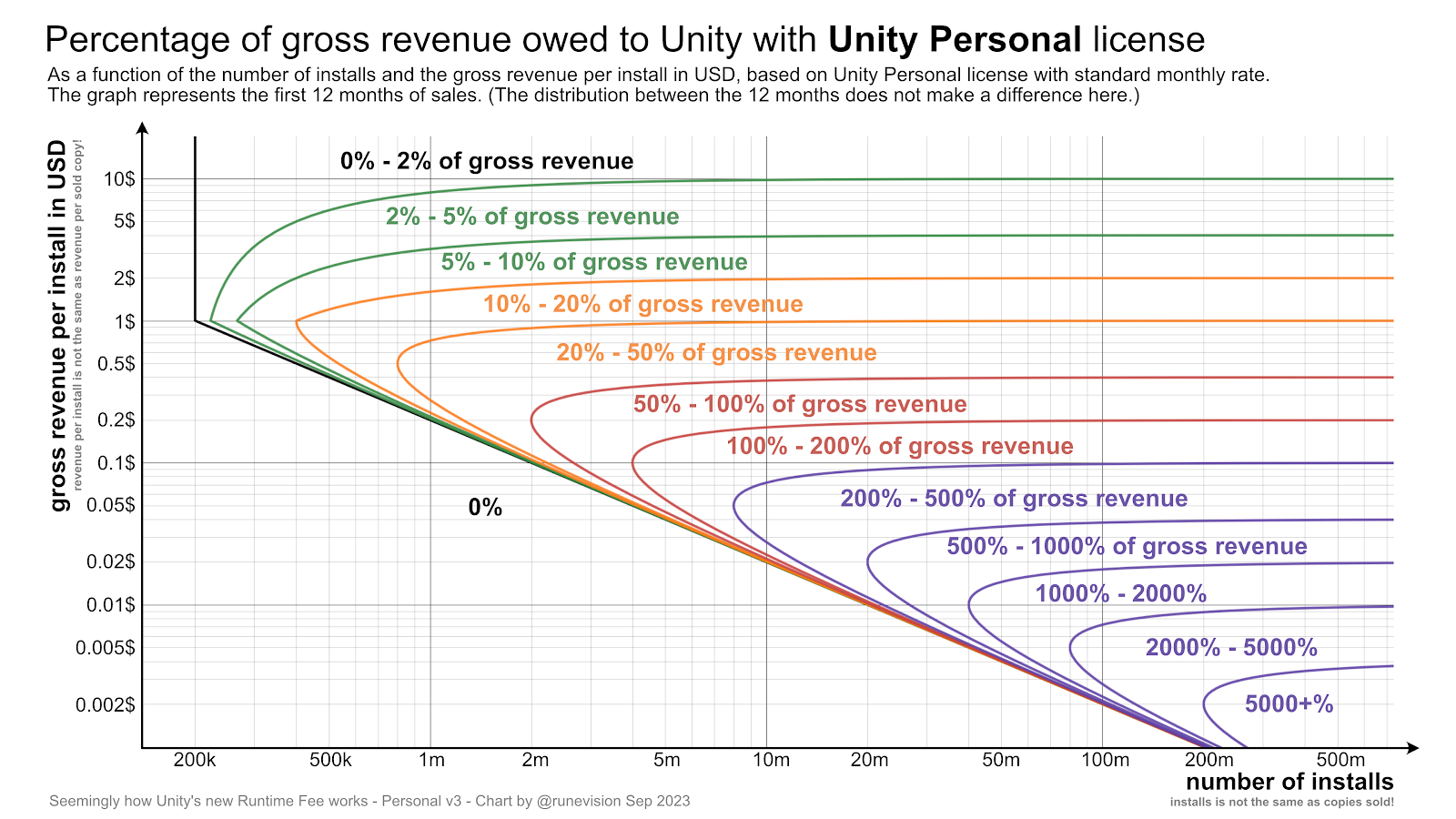
Unity Technologies has announced a new Unity Runtime Fee that charges developers a fee of up to $0.20 per installed game above certain thresholds. According to my calculations, it can be a bankruptcy death-trap, at least in certain cases.
Shockingly, the owed percentage is unbounded to the point that the owed amount can exceed gross revenue, since it depends on installs, not sales.
Update 1: Unity since backtracked and apologized for the announced changes. With the new updates to the terms, Unity will clamp the install fees to be at maximum 2.5% of revenue. And the changes will not be retroactive after all. Furthermore, John Riccotello is stepping down as CEO. There are more details in the linked blog post.
Update 2: About a year later, Unity canceled the runtime fee altogether. Good.
Nevertheless, Unity has suffered a tremendous decrease in trust and goodwill, which already was not great before. With the cancellation, there is less urgency for developers to switch to a different engine, but the whole situation has highlghted the importance of being prepared for such a scenario and have eyes and ears open towards other engines as well.
The original post continues below.
You can check out the specifications in their blog post. Based on those, I've made two charts where you can look up how big a percentage of your gross revenue you would owe Unity, based on the number of installs and on how much revenue you make for each of those installs. The fee specifications are different for Unity Personal and Unity Pro, so there is a chart for each.
Behind the design of Eye of the Temple
My VR adventure Eye of the Temple, that I've been working on since 2016, has landed on the Meta Quest 2! It was released last week on April 27th.
Get Eye of the Temple for Quest 2 on the Oculus Store
Originally released for SteamVR in October 2021, so many people have asked for it to be brought to the Quest 2 as a native app, so I'm happy it's finally a reality. The Quest 2 version was co-developed with Salmi Games and it took all our combined and complimentary skills to bring the game to life at target framerate on the Quest 2 mobile hardware.
We also made this new trailer:
The game got a fantastic reception! UploadVR called it "A Triumphant Room-Scale Adventure" and has labeled it an essential VR experience, and it got great video coverage by Beardo Benjo, BMFVR and many others. It also got great user reviews and a high review score on the Oculus Store.
Behind the design
To mark the Quest 2 launch of Eye of the Temple, I've written no less than three articles - published elsewhere - about different aspects of its design.
The Origins and Inspirations of ‘Eye of the Temple’
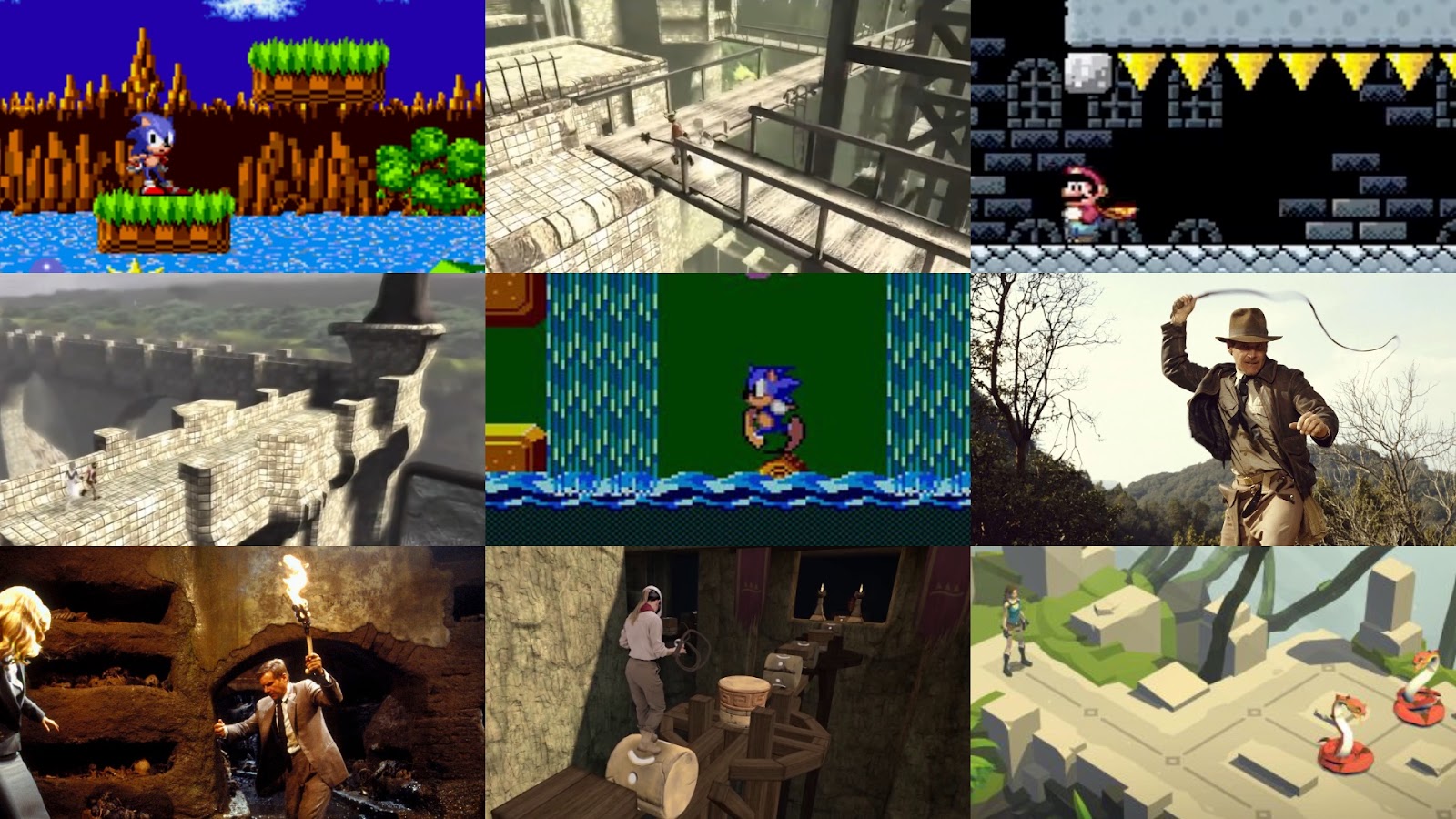
To celebrate the launch, I spoke with Meta about the origins of Eye of the Temple and the wide variety of inspirations (from classic platformers to Ico and Indiana Jones) behind the game.
Read the article on the Meta Quest blog
One year later...
Today is the one year anniversary of the release of my VR adventure Eye of the Temple on Steam! It's currently 40% off to celebrate.
I thought I'd take a moment to talk about what I've been up to since the release, both related to Eye of the Temple and other projects.
My experience launching Eye of the Temple
My VR adventure Eye of the Temple, that I've been working on for the past five years, has finally shipped! It was released last month on October 14th.
Naturally this was a huge milestone for me after having worked on it for so long. And while I've released some smaller games for free in the past, Eye of the Temple is my commercial debut game. I actually did it! Wow, I say, patting myself on the back.

Designing for a Sense of Mystery and Wonder

I play games to get to explore intriguing places, while challenge and story is secondary to me. But there still has to be a point to the exploration. I don’t want to just wander around some place - I want to uncover something intriguing and ideally mysterious. But the mystery lies not in the uncovering; it lies in the anticipation, or rather the lack of knowing exactly what I might find. In this article I examine that sense of mystery and wonder that’s tied not to story or themes, but to exploration. I’ll be using the word mystery as a shorthand for the kind of mystery and wonder I’m talking about here.
Zelda: Breath of the Wild from 2017 is an amazing game to go explore in, and one of my all time favorites. That said, while there are many things in the game that exude a sense of mystery - and certainly more so than in the average open world game - there are also a lot of missed opportunities.

I’ll compare Zelda: Breath of the Wild (BOTW) with Zelda: A Link to the Past (ALTTP) to try to figure out why ALTTP has a stronger sense of mystery than BOTW. A Link to the Past is a much older Zelda game from 1991 but I first played it in 2019.
Along the way I’ll be extracting four key design strategies for evoking a greater sense of mystery, and apply those strategies in the form of proposed design changes to BOTW. Finally, I’ll touch on some more general considerations to keep in mind when designing for a sense of mystery and wonder in general.
Getting TortoiseHg on Windows to work with SourceHut's SSH authentication
You can skip to the header below for the actual guide. Or stay here for a rambling preamble.
I'm a skilled programmer, but I'm not a technical person. I'm not good with computers. Or at least I highly prefer if things just work, and I don't have to fiddle with settings and configurations.
This is one reason I strongly prefer Mercurial for source control over Git. It has a higher degree of just working. (I don't want to get into an argument over this. You can question my assertion, but my preference is my preference in any case.)
Unfortunately Mercurial has become a niche choice as Git has achieved overwhelming popularity, largely due to GitHub. I wouldn't really have cared about that, except it made BitBucket close down their support for Mercurial some time ago. And BitBucket was a hosting solution for Mercurial that was affordable and also just worked.
I and many other Mercurial lovers have then had to find alternative hosting. And I ended up with choosing SourceHut. SourceHut is the opposite of "it just works". It's made for people who identify with hacking and tinkering and knowing all the technical stuff. Why did I choose it then? The "just works" alternatives had pricing that just did not work for a game development use case.
Now, SourceHut has been a pain to use in many ways for a non-technical person like me, but I've had the most pain at all trying to get SSH authentication to work. Unlike BitBucket, SourceHut does not allow HTTPS authentication, so you have to use SSH, and nobody ever sat down and made SSH easy to use on Windows.
Getting SSH to work involved juggling things like multiple types of SSH keys and formats all placed in a hidden folder, many different helper tools, and reading dozens of half-baked how-to guides that all contradict each other, often assume prior knowledge, and that are all for slightly different use cases which means they didn't quite work for me.
I got it all to work around a year ago, but I recently wiped my hard drive and needed to do it all over. I couldn't remember anything, so had to figure it all out all over again. So now I'm writing my own half-baked guide, mostly for my future self in case I need it again, but others might stumble over it and maybe find it useful too I guess.
When you read this guide, you might think it doesn't sound that complicated after all. But remember the guide omits all the things I read I should do and which I thus attempted, but it didn't work, and eventually turned out not to be needed anyway. Like running the main PuTTy application, or running tortoiseplink, or editing your mercurial.ini file. Anyway, on to the guide.
Goodbye Unity
Today is my last day at Unity.
It's been nearly 12 years since I joined the then-tiny startup with ~20 employees. Now there's over 3000 and it's been quite the ride to be part of this company while it has evolved, especially with the big role it has had in evolving the whole game industry too.
Lately I've been longing to do something smaller again, and so it's time for a new adventure in my work life to begin. Starting next week, I'm a full time indie developer!

For a start I'll be wrapping up my VR action-adventure game Eye of the Temple that I've been working on part time for the past 4 years. There's a demo on Steam already that has very positive reviews and I expect the full game can ship in early spring 2021.
What I'll do after is not fully settled yet, but I have an idea for a (non-VR) game set in a big forest full of ruins, strange artifacts, pathways and mysteries that I might begin working on next year.
My mental state at the moment is kind of a mixed bag. On the one hand I'm very excited about future possibilities and being able to work on exactly what I want. On the other, my motivation and productivity is a bit flaky these days. I don't know the exact reasons, but possibilities could include:
- Uncertainty about what my everyday life will be like (though economically I'll be fine!).
- Having felt unfulfilled work-wise for a good while before I quit.
- Having moved to a new country this summer (from Denmark to Finland), in the middle of a pandemic where it's hard to meet new people.
- Being in the end stretch of developing a game where it's mostly boring stuff left.
- Dark winter setting in - that normally doesn't affect me much but could be a compounding factor still.
However, I'll go easy on myself and just accept my productivity and motivation not being at its greatest right now. Perhaps I won't hit the ground running in my new indie life, but that's okay. I didn't have that much vacation this year either, so I'll see this as a chance to take it a bit easy for a little while while I adjust to my new life.
All in all, not a bad place to be, and I'm excited about the future!
Eye of the Temple in 2019
I've completely failed to keep up the posting in 2019, but it's not too late to write at least one post this year! Here's (almost) everything that happened with the development of Eye of the Temple in 2019!

But first, let's look at what happened in the last part of 2018 after the previous post.
Creaking Gorge and The Cauldron
Since my last post in July where I finally got a vision down for the level design in Eye of the Temple, I've been feeling super productive adding new areas and features to the game.
In August I added two new areas and in September I've been revamping the in-game UI and the speedrun mode. Only problem is I haven't kept up with these blog posts. To avoid this post getting too long, I'll cover the new areas here and save the UI work for a later post.
Creaking Gorge
Creaking Gorge is an area where you move along and into cliff sides and atop wooden scaffolding. It's by far the most vertical area in the game, spanning more than 50 meters vertically.

Level design workflows
Let me talk a bit about my workflows for doing level design in Eye of the Temple since I recently had some progress in that area.
I've been in something akin to a level design writer's block for a long time, being able to rework individual small areas, but unable to start the major world redesign that I've been intending for over a year.
Maybe calling it writer's block is pretentious - the fact is that I've never done this sort of work before, so I may just not have developed the necessary workflows to deal with it. Anyway, I think I might have finally cracked the nut.
I've had plenty of ideas, but fragmented and not crystallized enough to get down on paper. How do you start planning a non-linear world meant to be highly interconnected and interdependent? I can talk about what eventually worked for me.
I've long pondered what type of document could help me get ideas down on paper in a quick way. In addition to text documents (glorified to-do lists) I've been using tilemaps for sketching level designs.
I've been experimenting with using Unity Tilemaps as a digital replacement for pencil level design sketches. Some success so far, although I'm really missing rotation/flipping of selection and proper multi-selection.
— Rune Skovbo Johansen (@runevision) November 27, 2017
