2023 retrospective and goals for the new year
2023 was a pretty good year for me!
I'll touch here briefly on my personal life, then go on to talk about the Quest 2 release and sales of Eye of the Temple, and finally talk about my new game project and goals for 2024.
Personal life
It's the first year since the pandemic that didn't feel affected by it. I moved from Denmark to Finland in 2020, just as the pandemic began, so on the social side it was some slow years initially.
Things picked up in 2022, but especially in 2023 we had lots of family and friends from Denmark visit us here and have a great time, and we also made more strides on the local social network front.
Particularly memorable was a wonderful weekend celebrating the 40th birthdays of me and a friend, with some of my closest family and friends from Denmark and Finland at a site called Herrankukkaro in the beautiful Finnish archipelago.
Eye of the Temple released on Quest and turned a profit
In April 2023, a year and a half after the original PC release on Steam, my VR game Eye of the Temple was finally released for Quest 2, with the help of Salmi Games. While it was super tough getting there, in the end we managed to ship the game at a level of quality I'm very proud of. Others agreed; it got a great critical reception, as well as a high user rating of 4.7 out of 5 stars.
It's super gratifying regularly seeing new reviews of the game from people who say it's the best VR experience they've had. Oh, and recently, UploadVR ranked it the 5th best game for Quest 3 and Screen Rant ranked it the 6th best game for Quest 2. Wow, what an achievement for my little game! (But remember, critical acclaim does not equal sales…)
I’m no longer working on the game at this point. After being occupied with it over a span of seven years, I really want to move on, and I'm also done with VR in general for now. But the sales of the game are still developing, so let's talk a bit about that.
My thinking about the game’s sales performance has changed a lot over time. I didn't pay myself a regular salary during the game’s three years of full time work. But when evaluating the game financially, I use the old salary from my previous job as reference, and calculate whether my time investment at that salary (I’ll refer to it as just “my investment”) would be covered retroactively by the game’s revenue. Of course, I also keep in mind that the covered percentage would be higher if I based it on a more moderate salary.
I was initially slightly disappointed in the Steam sales. As I wrote about back in November 2021, the projected year one sales would only cover 25% of my investment. Back then I expected the Steam year one revenue to make up the majority of the game's lifetime revenue. One year later, the sales had outperformed that projection, and my investment was actually covered 40%.
A lot has happened since then, in particular due to the Quest launch.
Comments from many VR developers in 2021 and 2022 had indicated that Quest sales could commonly be 5x-10x as large as Steam VR sales. For Eye of the Temple, the Quest week one revenue was merely twice of what the Steam week one revenue had been, so it was not quite as high as Salmi Games and I had hoped for. Speaking with other VR developers in 2023, it seems that the time when Eye of the Temple launched on Quest was generally a bad period for Quest game sales.
Still, Quest is easily the most important VR platform, and later the sales picked up significantly, with the recent Black Friday and Xmas sales combined having as big an impact on revenue as the launch sales. Already, 70% of total revenue has come from Quest and 30% from Steam, with the Quest version having been out for a shorter time.

My investment is now covered 140%. In other words, even based on a proper salary for myself that's fitting for my experience, Eye of the Temple has recently flipped well into profitability. That still doesn't make it a runaway hit, but it's really nice to know that it's a success not only creatively and as a passion project, but also in terms of financial sustainability. Back in 2020 when I was still developing the game, I had not expected that at all for my first commercial title.
Behind the design of Eye of the Temple
My VR adventure Eye of the Temple, that I've been working on since 2016, has landed on the Meta Quest 2! It was released last week on April 27th.
Get Eye of the Temple for Quest 2 on the Oculus Store
Originally released for SteamVR in October 2021, so many people have asked for it to be brought to the Quest 2 as a native app, so I'm happy it's finally a reality. The Quest 2 version was co-developed with Salmi Games and it took all our combined and complimentary skills to bring the game to life at target framerate on the Quest 2 mobile hardware.
We also made this new trailer:
The game got a fantastic reception! UploadVR called it "A Triumphant Room-Scale Adventure" and has labeled it an essential VR experience, and it got great video coverage by Beardo Benjo, BMFVR and many others. It also got great user reviews and a high review score on the Oculus Store.
Behind the design
To mark the Quest 2 launch of Eye of the Temple, I've written no less than three articles - published elsewhere - about different aspects of its design.
The Origins and Inspirations of ‘Eye of the Temple’
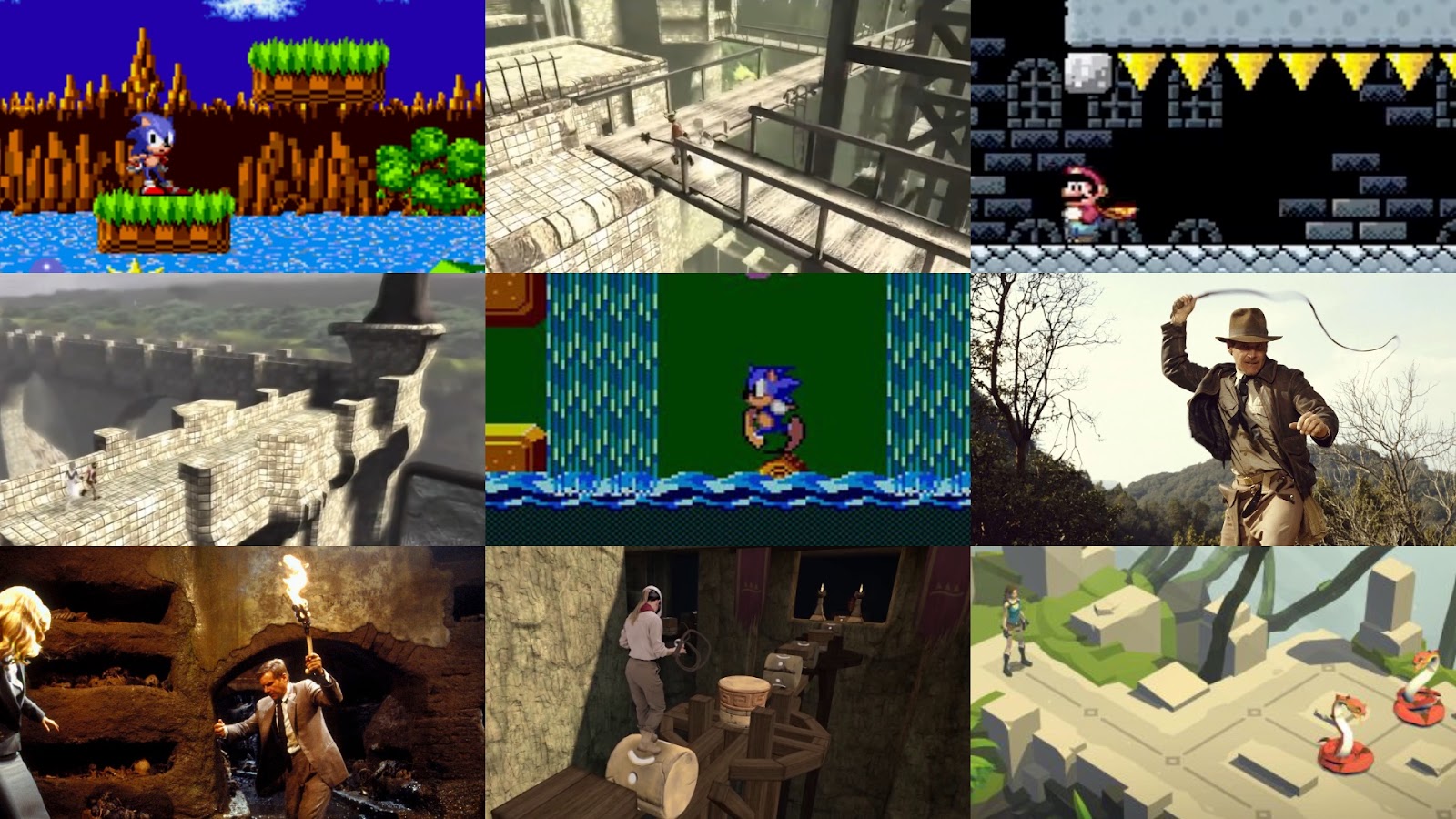
To celebrate the launch, I spoke with Meta about the origins of Eye of the Temple and the wide variety of inspirations (from classic platformers to Ico and Indiana Jones) behind the game.
Read the article on the Meta Quest blog
One year later...
Today is the one year anniversary of the release of my VR adventure Eye of the Temple on Steam! It's currently 40% off to celebrate.
I thought I'd take a moment to talk about what I've been up to since the release, both related to Eye of the Temple and other projects.
My experience launching Eye of the Temple
My VR adventure Eye of the Temple, that I've been working on for the past five years, has finally shipped! It was released last month on October 14th.
Naturally this was a huge milestone for me after having worked on it for so long. And while I've released some smaller games for free in the past, Eye of the Temple is my commercial debut game. I actually did it! Wow, I say, patting myself on the back.

Eye of the Temple in 2019
I've completely failed to keep up the posting in 2019, but it's not too late to write at least one post this year! Here's (almost) everything that happened with the development of Eye of the Temple in 2019!

But first, let's look at what happened in the last part of 2018 after the previous post.
Creaking Gorge and The Cauldron
Since my last post in July where I finally got a vision down for the level design in Eye of the Temple, I've been feeling super productive adding new areas and features to the game.
In August I added two new areas and in September I've been revamping the in-game UI and the speedrun mode. Only problem is I haven't kept up with these blog posts. To avoid this post getting too long, I'll cover the new areas here and save the UI work for a later post.
Creaking Gorge
Creaking Gorge is an area where you move along and into cliff sides and atop wooden scaffolding. It's by far the most vertical area in the game, spanning more than 50 meters vertically.

Level design workflows
Let me talk a bit about my workflows for doing level design in Eye of the Temple since I recently had some progress in that area.
I've been in something akin to a level design writer's block for a long time, being able to rework individual small areas, but unable to start the major world redesign that I've been intending for over a year.
Maybe calling it writer's block is pretentious - the fact is that I've never done this sort of work before, so I may just not have developed the necessary workflows to deal with it. Anyway, I think I might have finally cracked the nut.
I've had plenty of ideas, but fragmented and not crystallized enough to get down on paper. How do you start planning a non-linear world meant to be highly interconnected and interdependent? I can talk about what eventually worked for me.
I've long pondered what type of document could help me get ideas down on paper in a quick way. In addition to text documents (glorified to-do lists) I've been using tilemaps for sketching level designs.
I've been experimenting with using Unity Tilemaps as a digital replacement for pencil level design sketches. Some success so far, although I'm really missing rotation/flipping of selection and proper multi-selection.
— Rune Skovbo Johansen (@runevision) November 27, 2017

New pots feature, mixed reality, Discord server, Yonderplay event
It's time for a new update on the development of Eye of the Temple.

Events
GDC in March is well behind us and I had a great time there. Among other things, I got to show off Eye of the Temple at the European Game Showcase (and saw a lot of other cool games too). This was a private event for specially invited people from the network of the organizers.
Now, Eye of the Temple has been selected for Yonderplay, an event that's part of the Nordic Game Conference in Malmö in Sweden and open to everyone at the conference. This will go down on May 25, the last day of the conference. This is the most public showing of the game yet, and I'm very excited about it! If you'll be at Nordic Game Conference yourself, come by and say hi and give the game a try.

New trailer, public Steam page and Eye of the Temple in the press!
Last week I took a dive into the world of PR with Eye of the Temple.
There is a new trailer you can see on the website eyeofthetemple.com or right here below.
And Eye of the Temple now has a Steam page: Eye of the Temple on Steam
If you have a Vive or Oculus Rift, and think Eye of the Temple looks interesting, you can totally add it to your wishlist on Steam now! ;)
After that I took my first stab at contacting the press with a press release. The story got picked up by UploadVR and a handful of smaller outlets (see list on the Sanctum Dreams website). Considering I'm an unknown small indie developer with no experience with the press, I'm pretty happy with the results.
This week I'm at Game Developers Conference in San Francisco. I'm mostly here with Unity, but I'll also be showing Eye of the Temple at the European Game Showcase.
Exciting times!
January 2018 update
It seems like I didn't blog since July. How scandalous! Well, here's an update on what I worked on for Eye of the Temple since then.
Presented as a series of tweets, because that's what I have time for.
Note: Add blockers seem to sometimes randomly block some of the embedded tweets for some reason.
Prettier background environment
The cold snowy mountains didn't give the feeling I was aiming for. Failing to find anything ready-made that fit the bill, I created my own lush, mountainous environment.
What do you think of this new environment art for the backdrop of the temple that we've been working on? #gamedev #indiedev #VR #HTCvive pic.twitter.com/ASGxGCeG3p
— Eye of the Temple (@eyeofthetemple) September 20, 2017
Another shot of the mountains surrounding the temple. #screenshotsaturday #gamedev #indiedev #VR #HTCvive #madewithunity pic.twitter.com/GmfAwyzPvp
— Rune Skovbo Johansen (@runevision) September 23, 2017
Failed attempts at mixed reality capture with StereoLabs ZED stereo camera
I think a mixed reality video would be the ideal way to show off Eye of the Temple, so I invested a bit in this. Unfortunately it didn't go well due to a combination of a bad choice of immature tech, and an insufficient green-screen setup. I might revisit this in the future though.
@stereolabs3D Could you show how this 3D printed mount is meant to be used with a Vive controller and tracker respectively? pic.twitter.com/UqoEm0E77v
— Rune Skovbo Johansen (@runevision) September 16, 2017
It's designed to hold a Vive controller, a tracker and even an oculus touch. pic.twitter.com/yc4fC2J5ZJ
— Stereolabs (@Stereolabs3D) September 16, 2017
I posted a video here with my troubles. See tracking issue at 8:04. I mailed your support with more details. https://t.co/DCk6KeRO0O
— Rune Skovbo Johansen (@runevision) September 23, 2017
Argh! Mixed reality recording is hard! #VR #mixedreality #HTCVive #indiedev pic.twitter.com/YWVH6oFgc9
— Rune Skovbo Johansen (@runevision) September 26, 2017
Glowy light for certain platforms
Any Unity shader experts who might know why I get heavy banding on alpha of frag function output on Windows (but not Mac)? pic.twitter.com/Xrq8CliYNo
— Rune Skovbo Johansen (@runevision) October 16, 2017
I made a spiky glow for this platform. Helps a bit with awareness of edges without having to look down all the time. #VR #gamedev #indiedev pic.twitter.com/I9ScvbmzZL
— Rune Skovbo Johansen (@runevision) October 17, 2017
New build for testers with whip and other improvements
I finally finished developing the whip and got a build out to the testers.
Trying to recruit people to test the speedrun mode (never had any luck!)
The speedrun mode is super fun and challenging to me, but nobody else seem interested in it. Besides asking on twitter I also contacted some of the notable VR speedrunners and people who has posted about VR speedrunning on Reddit, but got nothing out of it. If anyone reading this have a Vive and would like to try it, do let me know!
#speedrunning in #VR with #HTCVive? Anyone want to give the speedrun mode of @eyeofthetemple a go? https://t.co/6g2WSQ2jnT pic.twitter.com/MtVtMKdLC0
— Rune Skovbo Johansen (@runevision) October 26, 2017
Implemented a new type of dangerous rooms for the temple
The reviews for this feature are through the roof.
Watch out! Working on a new type of danger in @eyeofthetemple... #screenshotsaturday #gamedev #indiedev #VR #HTCVive pic.twitter.com/95uYeL3b86
— Rune Skovbo Johansen (@runevision) October 28, 2017
It's getting tight in here. @eyeofthetemple #screenshotsaturday #gamedev #indiedev #VR #HTCVive pic.twitter.com/Tvrd3OcWk2
— Rune Skovbo Johansen (@runevision) October 28, 2017
"What do you mean I have to get in there!?" New room in @eyeofthetemple #screenshotsaturday #gamedev #indiedev #VR #HTCVive pic.twitter.com/7lE2iqorVD
— Rune Skovbo Johansen (@runevision) October 28, 2017
Got serious working on the big level design overhaul
Still far from finished with this one.
I've been experimenting with using Unity Tilemaps as a digital replacement for pencil level design sketches. Some success so far, although I'm really missing rotation/flipping of selection and proper multi-selection. pic.twitter.com/jT2PZloAYE
— Rune Skovbo Johansen (@runevision) November 27, 2017
I'm using #unity3d tilemaps for level design planning of multi-story structures. Moving things around becomes a pain though; having to do it separately for each layer. Any better alternatives? pic.twitter.com/STSb8AarvB
— Rune Skovbo Johansen (@runevision) December 29, 2017
Worked on a texture tool "Bricker" to easily create bricks and carved shapes
I've been continuing refining my tool for generating textures+normals from simple color masks. Output quality is getting there... #gamedev pic.twitter.com/jWzCUdc6Oz
— Rune Skovbo Johansen (@runevision) December 11, 2017
More on that in another post.
Contracted a few pieces of concept art to get inspiration for improving the visual look of the game
I've had decent progress towards realizing the concept art vision for @eyeofthetemple. I'll put further work on that on hold for now and focus again on a level design overhaul. #gamedev #indiedev #screenshotsaturday #VR #HTCvive pic.twitter.com/csUc4C5o7p
— Rune Skovbo Johansen (@runevision) December 23, 2017
And finally, introduced this little birdy
Bird spotted by the temple. #gamedev #indiedev #VR #HTCVive #birds pic.twitter.com/x8W7IRm54g
— Rune Skovbo Johansen (@runevision) January 15, 2018
That's it for now. Hope you enjoyed this glimpse into the development, and see you soon. Back to working on the game for me!
Remember you can also follow the development as it happens following @EyeOfTheTemple or @runevision on twitter.
July update: Trials and triumphs of whips and levers
Here's the latest updates on the development of my Vive VR game Eye of the Temple.
For the past several months I've been working on improving the whip I prototyped last year. In the last post, I showed how it could grab levers, but there were a lot of issues and the whip and lever didn't exactly look pretty. Now see what it looks like now:
This feels really good to use now. It didn't get to this point without a lot of issues on the way though.

June update: Verticality, puzzles, whip
Here's the latest updates on the development of my Vive VR game Eye of the Temple.
For the past month I've been mainly working on improving the whip I prototyped last year. It can now be used to grab levers at a distance, and then you can yank the whip backwards to activate the lever.
Testing whip and lever in Eye of the Temple. Still some way to go, but getting there. #gamedev #indiedev #vr #HTCvive pic.twitter.com/8TZHflQnM2
— Rune Skovbo Johansen (@runevision) May 20, 2017
There's still some way to go, especially with getting the audio cues right. The physics will never be quite like a real whip, but making it satisfying to use is the top priority.
Apart from this I've been looking into designing more puzzles for the game. I'm no expert puzzle designer, but bit by bit I come up with some that I think work well. The latest involve tall rotating towers, activated by levers (no whip use necessary for this one) where you need to step around on and in them at two different levels.
This also marks my increased effort in making better use of verticality in the level design. Experiencing the great heights is a draw of the game, and I'm figuring out how to use that optimally.
"Add more verticality" they said, and I agree! New puzzle elements in @eyeofthetemple #VR #HTCVive #madewithunity https://t.co/hvxgYxW0uR pic.twitter.com/tjDuCk2ufo
— Rune Skovbo Johansen (@runevision) June 13, 2017
I don't have a new build with these new things yet. The work right now is on smaller isolated pieces and puzzles, and once I have a set of those that fit nicely together, I'll begin integrating it all back into the overall world design.
April update: Fire, blades, speedrun mode
Here's the latest updates on the development of my Vive VR game Eye of the Temple.

New additions:
- Fire! One challenge tunnel now has fire hazards.
- Blades! One challenge tunnel now has swinging blades.
- Speedrun mode! A more challenging way to play the game. More notes below.
- Hat! You're now wearing a hat. Hope you like hat.
- Experimental spectator camera. 3rd person view. More notes below.
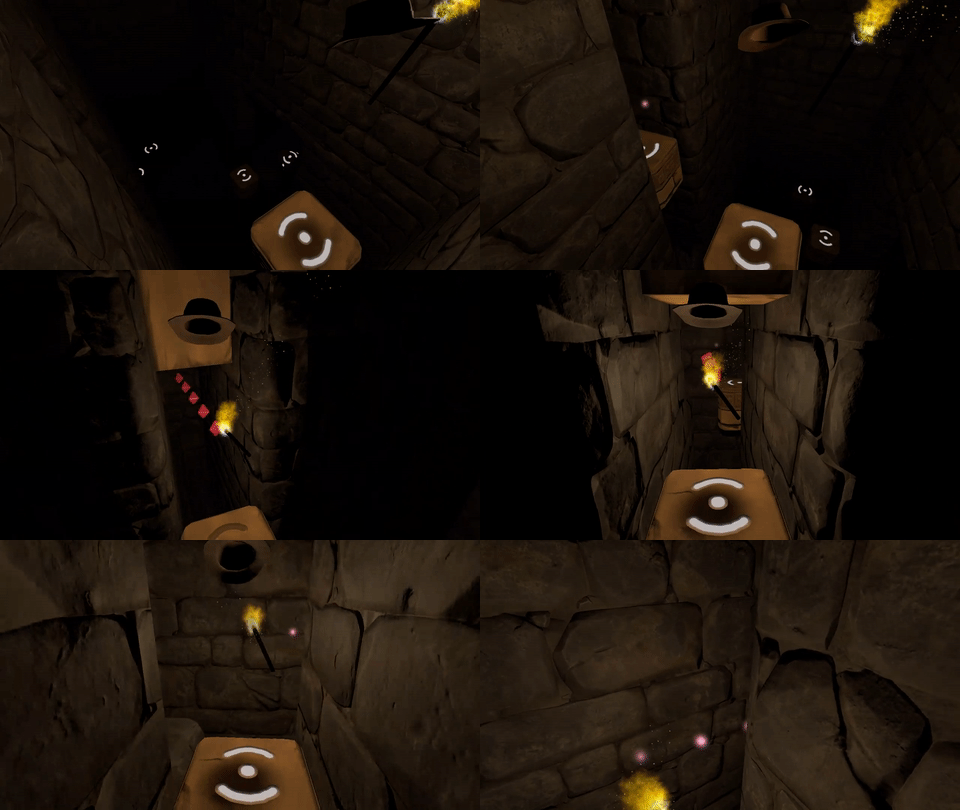
- Field of view is now restricted when close to falling and when falling in order to further reduce risk of motion sickness.
- Placeholder ambient soundscape taken out of the game for now since it had confusing footstep sounds.
Speedrun mode
For those of you who wanted more challenge in the game, there is a new speedrun mode. This mode times your play-through but also speeds up the platform movements as long as you can keep up.
This mode is has a higher risk of being uncomfortable, causing motion sickness, and falling over, so engage on your own risk.
- Each time you take a perfectly timed step onto a new platform, the game will speed things up a little bit.
- Each time you miss an opportunity to step onto a new platform, the game will slow things down a little bit. (This can occasionally happen through no fault of your own.)
- When you die, the speed is reset, so it's recommended to keep to a speed you can handle in order to not lose momentum in your speedrun. You can avoid speeding thing further up by taking steps in a slightly slower way.
I do not recommend this mode to people who haven't already played through the game at least once, so in the final game I'll probably only unlock the speedrun mode by completing the game.
How to use: For now though, you start a speed run by first starting a new game, and then press Shift+R on the keyboard.
Experimental spectator camera
The gameplay in Eye of the Temple can be hard to get an impression of for others by looking out in first person. I've experimented with an alternative camera angle shown on the monitor that shows the action from 3rd person perspective.
How to use: Activate/toggle 3rd person spectator camera by pressing X on the keyboard.
This view requires extra resources from your computer, so if you get performance problems, turn it off.
What do you think of 3rd person spectator camera? Is it something you might use for streaming, videos, or for people watching you play? It's still a bit buggy and has room for improvement, but I'm curious what you think of the overall idea.
February update: Gems
Here's the latest updates on the development of my Vive VR game Eye of the Temple.

New features:
- There are now gems throughout the temple that you can collect.
- Moving platforms have glowing symbols on them.
- Visuals: Intro area has some red stones and some of the dungeons have grittier gray stones and spikes.
- The way the platforms move has been tweaked, hopefully to further reduce potential for dizziness.
Notes on gems
The gems are found throughout the temple. The exact placement tries to take player proportions into account so that they are at a comfortable distance for reaching. I haven't tested this on different people yet though. If you could let me know how it works for you and how tall you are, that would be helpful. If you don't want to share that, that's ok too.
Right now the gems don't do anything yet. Later I will implement at the minimum a way for you to see how many you collected.
Beyond that I need to decide if the gems have a critical or non-critical function:
A critical function of the gems could be if they are used to unlock new areas in the game and thus are needed to progress. Or an almost-critical function would be to unlock alternative paths or secret rooms not otherwise accessible. This is still fairly critical because it would be annoying if you're trying to see 100% content of a game to find out you can't due to some mistake made earlier that's too late to do anything about. Currently there are one-way platforms that you can take which will prevent you from going back to collect any gems you might have missed. If I make the gems critical, I'd have to find a way to make it possible to always go back to all areas of the temple.
Non-critical functions of the gems could be high-score, achievements, and, I dunno, unlockable hats if I get a selfie stick implemented for the game. :P Old games would typically grant you extra lives, but it doesn't work for modern games with infinite lives.
For now I refrained from placing gems at platforms that only go one way. If there were gems there and you failed to pick one up, you wouldn't have a second chance and I thought that might feel unfair or frustrating.
Early testers online forum
In order to try to get faster feedback and shorter iteration cycles, I opened up for people to sign up online to be early testers of the game. If you have access to a Vive (and 2.2 by 2.2 meters space) and would like to try out the game and provide detailed feedback based on your experience, please don't hesitate to join!
Sign up to provide feedback on early builds of Eye of the Temple
January update: Visuals, usability and early testing
For a while, my focus for my Vive VR game Eye of the Temple have been to not expand more on gameplay right now but rather on improving what I've got in order to make it as presentable as possible.
That has meant:
- Improving visuals.
- Addressing usability issues found in play-testing.
(If anybody wonder what happened to the Whip Arena spin-off game, I put that on hold after it become clear it only worked well with a quite large physical VR space, which very few people have available.)
3D models
Gate model. Two keys must be inserted above the gate to unlock and open it:

Stone torch model. You light these with your torch to trigger things happening:

Cliffs model. The temple used to just float in the air; now it's grounded:

For a long time the game was full of placeholder models made of simple boxes and cylinders. There's still some of those left, but I've been working on replacing them all with proper models.
After briefly planning to work with contractors for 3D models, I decided to learn 3D modeling myself instead (and deal with the various challenges that come with it).
The models I need have highly specific requirements (they need to have very exact measurements and functionality to fit into the systems of the game) yet in the end they are quite simple models (man-made objects with no rigging).
With this combination it turned out that back-and-forth communication even with a very skilled artist took as much time as just doing the work myself. I'll still be working with artists for the game, just not for the simple 3d models I need.
Several of the models still have placeholder texturing. I have an idea for a good texture creation workflow for them, but it will take a little while to establish, so I'm postponing that while there's more pressing issues.
Intro section
My goal is that Eye of the Temple should be a rather accessible game. You need a body able to walk and crouch, and not be too afraid of heights, but I want it simple enough to play that people who don't normally play computer games can get into it without problems.
This has largely been a success. Gamers or not, I normally just let people play without instructions, and they figure things out. My dad completed the whole thing in one hour-long session when he was visiting.
The game did throw people in at the deep end though, asking them right from the start to step between moving platforms four meters above the ground. Some people would hesitate enough to end up mis-timing their step and stumble, making the experience even more extreme right from the beginning.
To ease people a bit more in, I've worked on an intro section that starts out with only a 0.75 meter drop, and the first two platforms have no timing requirement. I have yet to get wide testing of this to see if it helps.

There is one particular problem I've toiled with for a while, which is to design a platform that bridges two spots in a compact manner. Why this is tricky relates to how the game lets you explore a large virtual space using just a small physical space.
Originally I had platforms rotating around a center axis, but that made some people motion sick who otherwise didn't have problems with the rest of the game.

I tried various contraptions to replace it, but they were complicated and awkward to use. My latest idea is using just a barrel-like rolling block, which is nice in its simplicity, and also a fun little gimmick to balance on once you understand how to use it.
Figuring out what you're meant to do is easy to miss though, as I found out with the first tester trying it. I have some ideas for a subtle way to teach it, but that will take quite some time to implement. For now I settled for slapping a sign up that explains it.

Early testers online forum
There is no substitute for directly observing people playing a game, but this is impractical for me to do frequently when I also have a full-time job. I'm lucky if I get to do it two times a month.
In order to try to get faster feedback and shorter iteration cycles, I've now opened up for people to sign up online to be early testers of the game. If you have access to a Vive and would like to try out the game and provide detailed feedback based on your experience, please don't hesitate to join!
Sign up to provide feedback on early builds of Eye of the Temple
Spin-off game: Whip Arena
I've spend the past few days at Exile (like a game jam but not a jam this year). I've envisioned having a whip in Eye of the Temple for a long time, and at Exile I began developing this whip mechanic.
In the main game, the whip is meant to be just one element in the gameplay, aiding in puzzles, like being able to grab and switch levers from a distance, and grabbing objects to pull towards you. However, for now I started out making a little self-contained game based just around the whip, so that I could focus on getting the feel right first.
At the end of Exile I had "whipped up" a little game I might call "Eye of the Temple - Whip Arena". Here's a video of the gameplay:
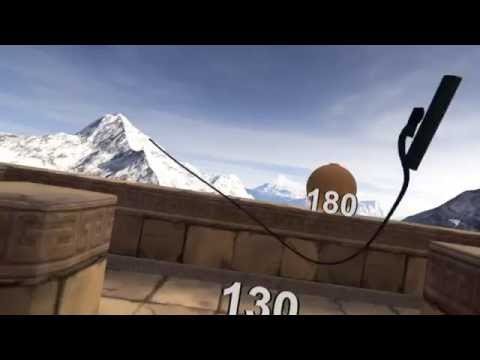
Implementing the whip physics was rather tricky. I've ended up with something that doesn't work quite like a real-world whip - you can't really make it do a crack in mid-air - but feels very responsive in its own way. The sound and haptics is based directly on the simulation, and I found it quite satisfying to use.
Now I'm wondering if I should take a little break from developing the full Eye of the Temple game and try to get this little arena game (which is much smaller in scope) finished and released first. I wonder if it's something people might be interested in? It definitely got positive reactions and feedback at Exile.
I'm thinking it would work well as an infinite game with high scores. There's not yet any fail condition though - I'm trying to think what might work well for that. I also need to implement some kind of bonuses and multipliers in the scoring probably.
As a side note - after spending several days prototyping and implementing this whip mechanic at Exile, I ended up with quite sore shoulders from whipping so much. ;)
If you have a Vive and would like to be an early tester of Whip Arena, let me know.
Announcing Eye of the Temple
I've been working on a VR game for the past months. It's called Eye of the Temple and it's a Vive game quite unlike any other.
Here's a pre-alpha trailer for it!
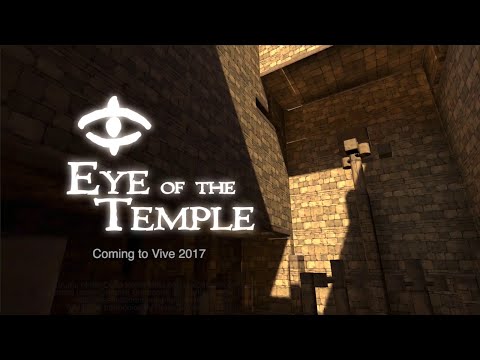
That's the first time I've made a trailer by the way. Quite challenging but also fun! It's got some placeholder models in it and it's made from playtest footage rather than clips made specifically for this trailer, but I tried to make the best of what I got.
Eye of the Temple is currently at an early stage in development.
Speaking of placeholder models, I'm just beginning now to look into working with contractors to have some nice art created for the game. If you know of any skilled concept artists or 3d modelers who'd like to design ancient contraptions for a game like this, let me know!
I previously worked on the game jam game Chrysalis Pyramid. Eye of the Temple is based on a similar core mechanic, but expands upon it in scope and variety, and is completely rewritten and redesigned from scratch. The goal is a commercial release in 2017.
Playtesting so far has been very promising and it's a lot of fun developing the game. Follow the development here and on Twitter, and let me know what you think!
Impressions and thoughts on VR and presence
Two weeks ago I was a week in Seattle for Unity's Unite conference. While in the city, I also had a chance to visit the Valve offices and try out their famous VR demos. The headset we tried was the one using QR codes to track alignment - not the newer "polka dots" headset they've been showing off too this summer, though I suspect the difference is not in performance but just in demands on the physical environment.

The guys from Valve were not only brilliant but also very friendly. We talked with them at length, and we were impressed with how they patiently and tirelessly showed the demos to each of us in turn, as well as taking us on a tour of the sizable office.

Like everyone else who have seen their VR have already said, the demos are amazingly effective. Though the pixels are visible if you look for them, the resolution is easily high enough to not be a problem. The world around you doesn't seem pixelated either; just a tiny bit blurry. Before I go on to praise the head tracking, let me get my one reservation out of the way.
Eye distance calibration and sense of scale
One reservation I have about the demos I was shown was that I felt only a limited sense of grand scale in those demos that were meant to showcase that. Most of the demos took place in virtual spaces of limited size (nothing was further away than about 10 meters) and those worked really great. The environment in those felt tangible and I felt a strong presence. However, a few demos placed me in environments with towering structures extending for what should amount to hundreds of meters, and those felt less real for me. In those environments it felt like objects that were supposed to be hundreds of meters away were maybe only 10 or 20 meters away, though it's very hard to judge when the perspective cues don't match the stereoscopic depth perception cues at all.
I suspect that lack of eye distance calibration (or interpupillary distance (IPD) to use the technical term) was the cause. The demos were setup to be easily viewed by many people in a row, and IPD calibration was not part of the process since it was deemed to not make a large difference. I would agree with that for the most part, though I think it does have a significant effect on the large-scale virtual environments and was the cause of the weaker sense of presence I felt in those.
Normally when a virtual object is supposed to be near-infinitely far away, the distance between it's left eye depiction and its right-eye depiction on the screen(s) of the headset should be the same as the distance between the centers of the eyes, so that the eyes will look out in parallel in order to focus on the two respective images. This will match what the eyes do in reality when converging on objects nearly infinitely far away. (For the purposes of human stereoscopic vision, anything further away than just about a hundred meters is practically infinitely far away.) If a person's actual IPD is larger than what is assumed in the VR setup (hardware and software), then the eyes will not be looking out in parallel when focusing on a virtual object nearly infinitely far away, but rather look a bit inwards. This will cause the eyes and brain to conclude that the object is in fact nearer, specifically at the distance where the focus lines of the two eyes converge and meet each other in a point.
What's worth noting here is that no amount of up-scaling of the virtual world can compensate for this. If the "infinite distance" makes the focus of the eyes converge 10 or 20 meters away, then that will be the perceived distance of anything from structures a hundred meters away to really distant objects like the moon or the stars. A corollary to this is that things in the distance will seem flattened, since an infinite amount of depth is effectively compressed into a few meters. This too matches my impression, though I didn't have much data to go on. One huge virtual object I encountered in one of the demos was of roughly spherical shape. However, it appeared flattened to me at first while it was far away, and then felt increasingly round as it came closer to me. You might say that things very far away also technically appear flat to us in reality, but in practice "flat and infinitely far away" doesn't feel flat, while "flat and 10 meters away" does.

Luckily, eye distance calibration is not a hard problem to solve, and Tom Forsyth from Oculus points out that the Rift comes with a calibration utility for this that people are encouraged to use. I should also say that none of my colleagues who tried Valve's demos had the same reservation as me about sense of scale. It could be that their IPD better matches what was assumed in the VR setup, or it could be that potential IPD discrepancies were just less apparent to them.
Approaches to head tracking
What I found most impressive about Valve's VR technology was that the head tracking and stabilization of the virtual world is basically solved. Unlike Oculus' Development Kit 1, the world doesn't blur at all when turning the head, and it feels completely stable as you look and move around. This makes the virtual world feel very tangible and real. You can read more about the technical details elsewhere, but it's basically achieved with a combination of low latency, high frame-rate, and screens with low persistence of vision, meaning that for every frame the screen only shows an image for a very brief period, being black the rest of the time. (Old CTR monitors and TVs were all like this, but it's not common for LCD screens.)
The tracking using QR codes worked very well then, except when it didn't. If you get close enough to a wall that the head-mounted camera can't see any one QR code fully, the positional tracking stops abruptly at that point. The effect is that of the world suddenly moving forward together with your head, until your take your head back far enough that the tracking resumes. This happened quite often during the demo and every time broke the immersion a lot while also being somewhat disorienting. Together with QR codes having to be plastered everywhere on the walls, going away from that approach is probably a good idea.
"For Crystal Cove, it's going to be just the seated experience"
Nate Mitchell, Oculus
I haven't tried the Oculus Rift Development Kit 2 (at least not its tracking), but from what I've heard, it's based on a kind of camera in front of the player, recording the movement of the headset. And supposedly, it only works while approximately facing that camera. Oculus have also been issuing comments that the Rift will be meant to be used while sitting, which matches up with that limitation. Having tried a few different VR demos, that seems awfully restricting. It will work mostly fine for cockpit-based games taking place inside any kind of car, spaceship, or other vehicle with a "driving seat" you stay in all the time. But for a much broader range of games and experiences, having to face in one direction all the time will be severely limiting or directly prohibitive. It's currently unclear whether the limitation is only for the Crystal Cove headset (Development Kit 2) or also for the final consumer version.
Freedom of head and body movement
Luckily there seems to be hope yet that even Oculus' headsets can be used for experiences with more free movement, whether Oculus themselves will end up supporting it or not. I had a chance elsewhere in Seattle to try out a demo of Sixense's tracking and motion controller technology (also described in this article on The Verge). Basically they had slabbed their own motion tracker onto the Rift headset, replacing the Rift's own head tracking, as well as equipping the player with two handles that are also motion tracked.

The VR demo to show it off with was one of being a Star Wars Jedi training with lightsabers against that Remote sphere that hovers and shoots lasers - albeit without being blindfolded as in the original movie. The tracking of both head and hands worked wonderfully, and allowed all the attention to be on the quite engaging gameplay.
While Valve's demos were the visually most impressive spaces to be inside, the Sixense demo was easily the most overall engaging VR experience I've had. Sony have sold one-to-one motion-tracking Move Controllers with the PlayStation for years, but solid motion tracking controllers combined with VR combines into an experience that's feels real and is intuitive at a whole different level.
The promise of waving stuff around with your own hands got mainstream with the Nintendo Wii, but the tracking was crude, and only mapped on a gestural level. You swung your hand to indicate swinging a racket, and the in-game avatar would trigger a racket-swing as well, but only with the approximate same direction and not with the same timing at all. Sony's Move Controllers fixed that, but still the sense of depth was missing and it still felt more like remote-controlling a utility rather than actually holding it in your hand, and you have only very little sense of whether your aim might be correct. This limitation will always exist as long as the visuals are not in stereoscopic 3D.

Using accurate motion tracking of the hands in VR produces an entirely different sensation. When I tried that lightsaber demo I felt like I was really holding those lightsabers, and swinging and turning it to block the incoming lasers felt like the most intuitive thing, even though I've never - eh - blocked lasers with a lightsaber in real life, or handled any kind of sword for that matter.
Personal style in VR
Equally impressing, when watching others play the lightsaber demo, it became apparent how much the demo and technology let people approach the gameplay with their own style and personality. Some would move the lightsabers only just enough to block the lasers, others would be swinging them more gracefully around, while yet others moved with big and stiff robotic-like moves. As the interfaces to VR begins to imitate and approach the way we move and interact with the real world, our mannerisms and ways of movement from the real world will begin to translate there as well.
To go back to the technical side of things, the Sixense technology is based on magnetic fields. A Valve employee said they'd been experimenting with tracking based on magnetic fields as well, but hadn't found it to be very reliable. Whether it's because they didn't account for disturbances in the magnetic fields as the people from Sixense claim to do, or whether it really is less reliable but just wasn't a noticeable problem in the demo in question is hard to say. What seems clear though is that there is loads of promise in these new forms of interaction, and that it will be very exciting to see what kind of experiences and interactions in VR we'll be having in the coming years.
Dulling of reflexes
While the advances in VR have made huge strides now in a very short time towards eliminating simulator sickness and making the virtual environments appear much more real to our senses, this potentially can have a negative side as well.
As the way the virtual worlds appear to our senses get increasingly closer to how the real world does, our motor skills, reflexes, and other instincts are also increasingly transferable from one to the other. While people don't have any problem having their avatar walk off the ledge of a cliff in a traditional 3D game, many people feel physically unable to walk off the ledge of a cliff in VR, while other can, but have a hard time forcing their body to do it. A positive side of this is that VR can be used to treat a variety of physical and physiological illnesses by performing training in VR where the results transfer to the real world.
Consider though that many game scenarios tasks players to be daring and bold, subjecting themselves to hazardous environments to overcome impossible odds. And consider that failing repeatedly without real consequence is a normal part of playing such games. In a VR game, a scenario might see you dodging large rocks being hurled towards you, and failure to do so might see you die in the game, but physically being unharmed in the real world. The natural reflex for most people in such a game will be to dodge the rocks not just for gameplay reasons but even purely instinctual as well. However, one might speculate that the more times the body and brain experiences being hit by a rock in the game with no physical consequence, the more the reflex to avoid the rocks will be weakened.
Imagine too that the game is hard and won't let you win if you duck and avert the rocks too aggressively, thus loosing focus on what's going on elsewhere around you. Instead you'll need to adapt to only just avert the rocks with minimal expenditure. Your chances of averting the individual rock will be a bit lower, but your chances of winning the scenario increases.
As reflexes and adaptations to stimuli can transfer between the real world and VR, can this adaptation towards ignoring the body's natural reflexes also accidentally transfer to the real world? Will people navigating hazardous virtual environments haphazardly have a risk of reacting less acutely to hazards in the real world as well?
As far as I have gathered, this is something we don't yet know very much about. Some studies have been made decades ago, but based on VR technology nowhere in the same league as what we're beginning to have available today. It seems to be an important area of study though, and I'll be curious to see what the findings will be.
In the mean time I will probably lean towards indulging mostly in VR experiences that let me peacefully enjoy strange and beautiful places and use some serious moderation with experiences that will put me in a sense of danger and test my survival instincts. Deflecting lasers will be exempt from this.